



Sharp Bones: CRKT Kalbi


Buy CRKT Kalbi at Knyfe

CRKT Kalbi 7540 Pocket Knife Blue Acuto 440 Aluminum Linerlock Flipper Plain Edge Trailing-Point
In stock
RRP: Original price was: 109,95€78,99€Current price is: 78,99€.| Overall Length | 19 cm |
|---|---|
| Blade Color | silver |
| Blade Thickness | 2.8 mm |
| Weight | 57 g |
| Item type | Pocket Knives |
| Blade Material | 440 |
| Handle Material | Aluminum |
| Opening aid | Flipper |
| Opening | Manual |
| Lock | Liner lock |
| Color | blue, black |
| Blade Length | 8.3 cm |
| Handle Length | 10.7 cm |
| Origin | Taiwan |
| Blade Shape | Trailing Point |
| Blade Execution | Plain edge |
| Sharpening Method | European knife grind, Flat grind |
| Blade Finish | Satin |
| Designer | Jeff Park |
| Blade height | 1.7 cm |
| One-handed opening | Yes |
| Pocket clip | Yes |
| Pocket clip side | right |
| Pocket clip position | Tip Up |
| promotions | Easter Sale, Spring Sale |
Although it doesn't bear the name, CRKT's Kalbi is the newest member of the "Crossbones family." What has it inherited from its predecessor, and what is new? By Rainer Fassnacht

In the older Crossbones, the crossed bones are found in the structure of the handle scales. In the new Kalbi, they are visible on the pivot screw. Photo: Rainer Fassnacht
The "Crossbones family" began with Hawaiian designer Jeff Park, who trained under Ken Onion. The latest addition to this knife family he founded is the Kalbi, the younger sibling of the Crossbones (Bronze). Although the family resemblance between the two is unmistakable, there are differences between the current Kalbi and the older Crossbones generation that catch the eye at first glance.

The rounded shape makes the Kalbi a real pleasure to hold. Photo: Rainer Fassnacht
The most obvious differences of the Kalbi compared to its older brother are the vibrant blue color of the aluminum handle and the less pronounced grip texture. The family heritage is evident in the similar outline and the crossed bones on the pivot screw.
Looking closer at the younger generation, it's noticeable that the Kalbi's blade has become 83,34 mm shorter at 6,47 mm. This small difference makes a big difference for numerous Americans, because in some US states, blades over 3 ½ inches are illegal. The Kalbi can be legally carried there (unlike its older brother).

The lanyard hole is well-sized and matches the black of the pivot screw. Photo: Rainer Fassnacht
Despite a shorter blade, the proportions remain harmonious because the handle and overall length have also been reduced – to 102,13 and 185,75 mm. The blade thickness has also decreased, measuring 2,69 mm on the Kalbi. These changes reduce the weight to a travel-friendly 56,70 grams.
Another improvement is the new blade steel; the Kalbi uses Japanese Acuto 440. This is a variant of 440C with more molybdenum and a small amount of vanadium added. The edge retention is significantly better than its predecessor. Additionally, this blade steel shows high corrosion resistance, is durable, and sharpens easily.

The structure of the older generation was more pronounced but too sharp-edged. Photo: Rainer Fassnacht
As with the old Crossbones, the Kalbi's blade is flat ground from the spine and satin finished. Its shape is somewhat reminiscent of a filleting knife and, along with the "ocean blue" color of the aluminum handle, contributes to the Kalbi's distinctive appearance.
Compared to the older brother, the texturing of the handle scales on the Kalbi is less pronounced, and the edges are rounded. This improves the hand feel and makes clipping and drawing the knife easier. The clip is located on the right side, cannot be repositioned, and holds the knife tip-up in the pocket. It is secured with an inserted liner.

Not only the fish off Hawaii admire the new Kalbi. Photo: Rainer Fassnacht
The textured flipper and the IKBS ball bearing allow for a smooth flip, while the generous lanyard hole in the backspacer lets you attach paracord with a larger diameter as a pull aid. A slightly ramp-shaped texturing on the rear of the blade provides grip at the top, while the flipper serves as a hand guard at the bottom. The backspacer and pivot screw are black, creating a successful color contrast with the blue of the handle scales.
The Kalbi has significantly improved in practicality compared to its predecessors. The visually appealing handle structure of the older and larger brother was a real eye-catcher but was uncomfortable to handle.
The new, less pronounced texture on the Kalbi is a real win for the user. The striking "Oceanblue" of the handle is particularly eye-catching and evokes associations with Hawaii, where the Crossbones family story began.
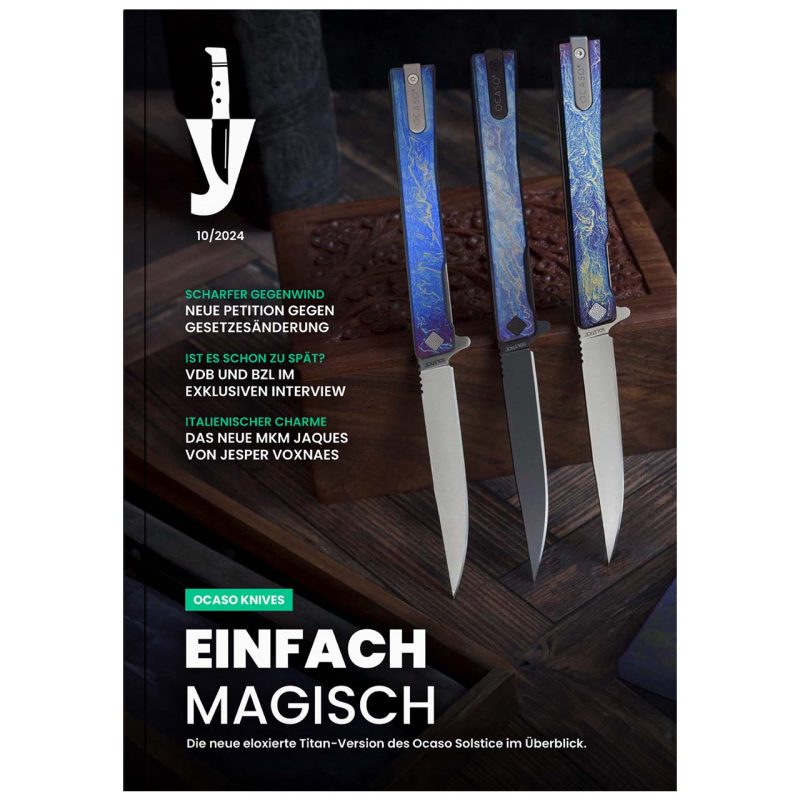
This article is part of the Knyfe Magazine 10/2024